HAMMER STRENGTH

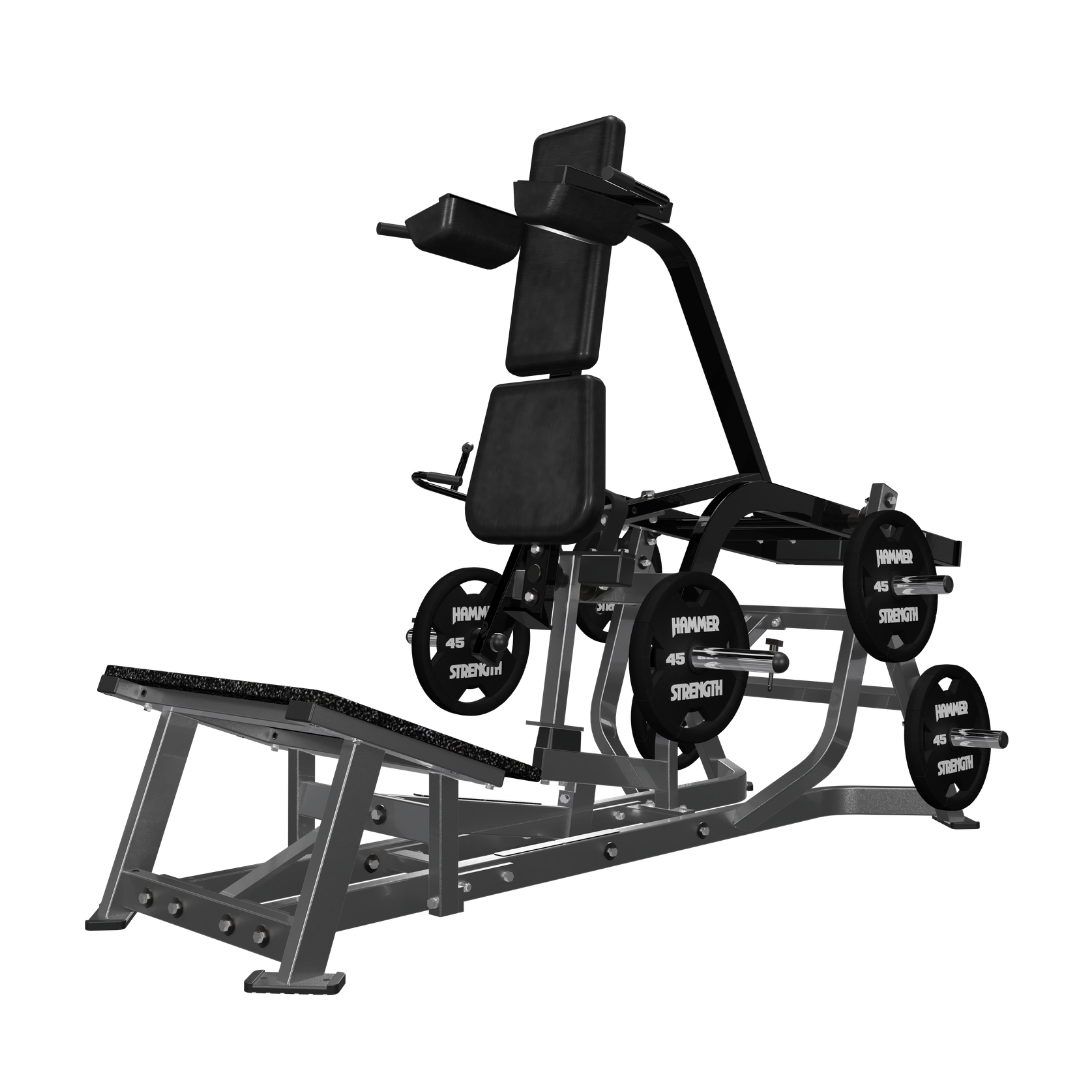
Hammer Strength Plate Loaded V-Squat

Hammer Strength Plate Loaded V-Squat

JUMP TO SECTION

KEY FEATURES

Push-Pull Racking Mechanism

KEY FEATURES

Ergonomic Handles

KEY FEATURES

Non-Slip Platform

It’s All About the Arc

A straight path might look clean on paper—but the body doesn’t move that way under load. The V-Squat’s curved arc is engineered to follow a more natural squatting pattern, reducing excessive shear on the knees and unnecessary compression on the lower back. This arc allows athletes to load up confidently and train harder, while still respecting the mechanics of the body. 

Power Your Leg Day with Confidence

There’s a fine line between stability and restriction—and our V-Squat machine walks it perfectly. The platform, back support, and foot angle give athletes the confidence to attack heavy reps, but the machine doesn’t force the user into a rigid, linear track. That subtle freedom allows lifters to press through their own natural mechanics—more like a real squat, less like a machine. 

Starting Resistance54 lb (25 kg)
Product CodePL-VSQ
Storage Weight Horns4
Recommended Plate Mix6 x 45 lb plates, 4 x 25 lb plates, 4 x 10 lb plates

What is the difference between the V-Squat and Hack Squat? Are they the same?
The V-Squat uses a natural, curved arc of motion that better mimics a free-weight squat. This reduces strain on the knees and lower back while keeping the movement pattern more aligned with real-world and sport-specific squatting.

How does the V-Squat protect my knees and lower back?
The curved motion path reduces shearing forces on the knees and minimizes spinal compression, allowing users to train heavily with less wear and tear on the joints compared to more linear machine movements.

How to adjust the V-Squat machine?
There are no adjustments to this machine. Even with no adjustments, it still accommodates a wide range of athlete shapes and sizes.

How do you use the Hammer Strength V-Squat? How does it differ from a barbell back squat?
The V-Squat offers a guided path that reduces balance demands while still allowing for a natural squat motion. This makes it a great tool for focused leg training, higher-rep volume, or working around injury—while still reinforcing real squat mechanics.
Scroll to Top